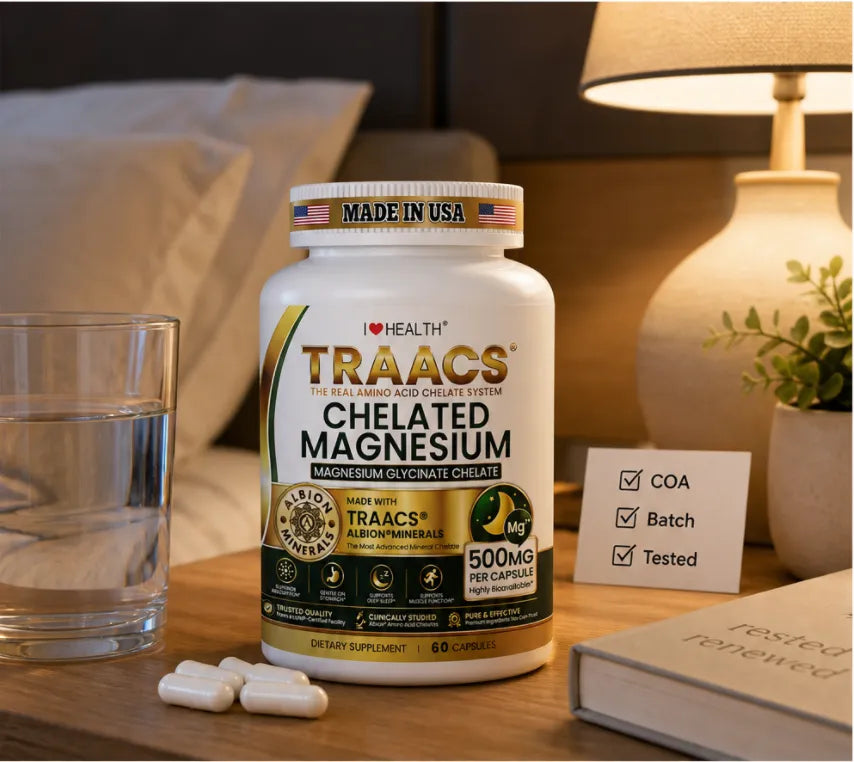

Magnesium glycinate is a practical first choice for sleep-focused use. It has direct human evidence and is commonly selected for digestive tolerance. Magnesium L-threonate also has sleep trials, but the results are mixed. Citrate, oxide, and blends may fit other goals, yet none is proven universally best for sleep.
What Type of Magnesium Is Best for Sleep?
Magnesium glycinate is the most reasonable starting point for many adults, but the answer is not absolute. A 2025 placebo-controlled trial found a small improvement in self-reported insomnia severity with magnesium bisglycinate. L-threonate has promising trials too, although a newer study found no improvement in objective sleep measurements.
The National Center for Complementary and Integrative Health states that rigorous evidence remains insufficient to determine whether magnesium supplements treat insomnia or other sleep disorders. Its magnesium and sleep evidence review also notes that much of the earlier research was small or low quality. Form choice should therefore balance evidence, tolerance, elemental dose, and your reason for taking magnesium.

Compare Sleep Evidence by Magnesium Form
The strongest comparison asks whether a form has direct sleep outcomes in humans. Absorption research and biological theories matter, but they cannot substitute for a trial that measures sleep.
|
Magnesium Form |
Direct Sleep Evidence |
Practical Fit |
Main Limitation |
|
Glycinate or bisglycinate |
One recent trial found a small improvement |
Sleep-first use |
Subjective, modest result. |
|
L-threonate |
Two small trials with mixed outcomes |
Cognition plus sleep interest |
No proven superiority; manufacturer-funded studies. |
|
Citrate |
No strong form-specific sleep result |
Regularity also matters |
May loosen stools. |
|
Oxide |
Used in some older sleep studies |
Low-cost, purpose-specific use |
Lower solubility and more digestive effects. |
|
Multi-form blend |
Finished-formula evidence required |
Broader form coverage |
Each form's contribution is unclear. |
No row proves that one form will improve your sleep. The table shows which question each type can answer and where the evidence stops.
Why Glycinate Is the Practical First Choice
Glycinate has the clearest recent form-specific evidence for self-reported insomnia symptoms. In a 2025 randomized, double-blind trial, 155 adults ages 18 to 65 with poor sleep received placebo or 250 mg of elemental magnesium as bisglycinate daily for four weeks. The magnesium group improved slightly more on the Insomnia Severity Index, but the effect size was small and the study did not use objective sleep measurements. The magnesium bisglycinate sleep trial does not establish a guaranteed result or an ideal dose for everyone.
Glycinate and bisglycinate usually name the same basic compound. That naming detail does not make one product more suitable for sleep, so our glycinate and bisglycinate guide handles the chemistry and label distinction in full.
A glycinate label may still describe a buffered or blended formula. If the source line includes another form, our buffered and non-buffered guide shows how to identify it. Composition affects what you are taking, but buffered status alone does not predict a sleep result.
Does L-Threonate Have Better Sleep Evidence?
No, L-threonate is not clearly superior to glycinate. A 2024 randomized trial included 80 adults ages 35 to 55 with self-assessed sleep problems. After 21 days, the L-threonate group had improvements in several wearable and daytime-function measures. The study was funded by the ingredient manufacturer, and three authors were affiliated with the funder, as disclosed in the L-threonate sleep trial.
A 2026 randomized trial gives a more cautious picture. One hundred adults ages 18 to 45 took L-threonate or placebo for six weeks. Sleep-related impairment improved on one self-report measure, but sleep disturbance, restorative sleep, and wearable-based sleep outcomes did not differ between groups. The funder supplied the ingredient and helped conceptualize the study. These details appear in the newer L-threonate trial.
L-threonate remains an evidence-backed form worth studying, especially for cognition-related questions. Current trials do not prove that it produces better sleep than glycinate, citrate, or another form in a direct head-to-head comparison.

When Do Citrate and Oxide Make Sense?
Citrate can make sense when magnesium intake and bowel regularity are both relevant. It is more soluble and generally better absorbed than magnesium oxide, but better absorption does not automatically mean better sleep. A systematic review of 14 bioavailability studies found that organic formulations were generally more bioavailable than inorganic ones, while absorption also depended on dose. See the magnesium bioavailability review for the comparison.
Oxide can still supply magnesium, but it is not our first sleep-focused choice. The NIH magnesium fact sheet reports that forms which dissolve well tend to be absorbed more completely than oxide and sulfate. It also lists oxide among the forms commonly associated with diarrhea.
These tradeoffs matter more than a generic ranking. Citrate may be useful when its digestive effect matches your goal. Oxide may fit a specific product, cost, or clinician-directed plan. Neither form has strong evidence that it outperforms glycinate specifically for sleep.
Do Multi-Form Magnesium Blends Improve Sleep?
Not necessarily. A blend can combine several magnesium sources in one serving, but the total elemental magnesium amount usually does not reveal how much comes from each form. Without a trial on the finished formula, you cannot assign a sleep effect to glycinate, citrate, malate, taurate, or another component.
A multi-form product may still be practical when you prefer broader form coverage or want one formula for several general magnesium goals. Judge the complete formula, serving size, other active ingredients, and available finished-product evidence. Do not assume that five forms are five times more effective than one.
How Our Magnesium Options Map to Different Goals
Our current range supports different form preferences without claiming that one bottle fits everyone. Our magnesium glycinate capsule line is the direct option when glycinate is your chosen form. Our 5-in-1 magnesium complex provides a multi-form alternative, while our magnesium citrate tablets fit shoppers who specifically prefer citrate.
Compare current formats in our magnesium and sleep support collection. For any option, confirm the elemental magnesium amount rather than relying on compound weight. Our elemental magnesium guide covers that label task without repeating it here.

Keep Form Choice Inside Safe Intake Limits
Safety depends on elemental magnesium, total intake, kidney function, and medications. The NIH sets the adult upper limit at 350 mg per day from supplements and magnesium-containing medications unless a healthcare professional recommends otherwise. Magnesium naturally present in food does not count toward this supplemental limit.
High supplemental intakes can cause diarrhea, nausea, and abdominal cramping. The risk of toxicity rises when kidney function is impaired because the body may not remove excess magnesium effectively. Magnesium also interacts with some antibiotics and oral bisphosphonates, while diuretics and proton pump inhibitors can alter magnesium status.
Ask a qualified professional before supplementing if you have kidney disease, are pregnant, take medication, or have ongoing sleep symptoms. Persistent insomnia, loud snoring, breathing pauses, unsafe daytime sleepiness, or rapidly changing sleep needs a clinical evaluation rather than a different supplement form.
Choose the Form With the Best Evidence Fit
Glycinate is the most practical sleep-focused starting point, while L-threonate remains promising but not clearly superior. Citrate, oxide, and blends fit different digestive, cost, or formulation goals. Choose by direct human evidence, elemental dose, tolerance, and safety rather than by a claim that one form works for everyone.
Frequently Asked Questions
Q1. Is Topical Magnesium a Better Sleep Option?
No clear evidence shows that sprays, oils, or bath products improve sleep better than oral magnesium. Skin products may feel relaxing as part of a bedtime routine, but that experience does not confirm meaningful magnesium absorption or correction of low intake.
Q2. Does Glycine Make Magnesium Glycinate a Sedative?
No. Glycine is part of the chelated compound, but magnesium glycinate is not a sedative drug. The glycine amount varies with the formula and dose, and a product should not promise immediate drowsiness or a predictable time to fall asleep.
Q3. Can Magnesium Chloride Be Used for Sleep?
Yes, magnesium chloride can supply absorbable magnesium, but it lacks a clear form-specific advantage for sleep. Choose it for an appropriate elemental amount and tolerable format, not because chloride itself has been proven to improve sleep more than glycinate.
Q4. Can You Take More Than One Magnesium Form?
It depends on the total elemental amount and your health. Different labels can make accidental stacking easy, especially when a multivitamin, antacid, laxative, or sleep blend also contains magnesium. Add every supplemental source before deciding whether a combination is appropriate.
Q5. Does Magnesium Status Matter More Than Form?
It may. A person with inadequate intake could respond differently from someone whose magnesium intake is already sufficient. Form affects absorption and tolerance, but baseline intake, health conditions, medications, and the actual cause of poor sleep can matter just as much.
Disclaimer
This content is for general educational purposes and is not medical advice. Dietary supplements are not intended to diagnose, treat, cure, or prevent disease. Ask a qualified healthcare professional before use when health conditions, pregnancy, medication, or dose concerns apply.