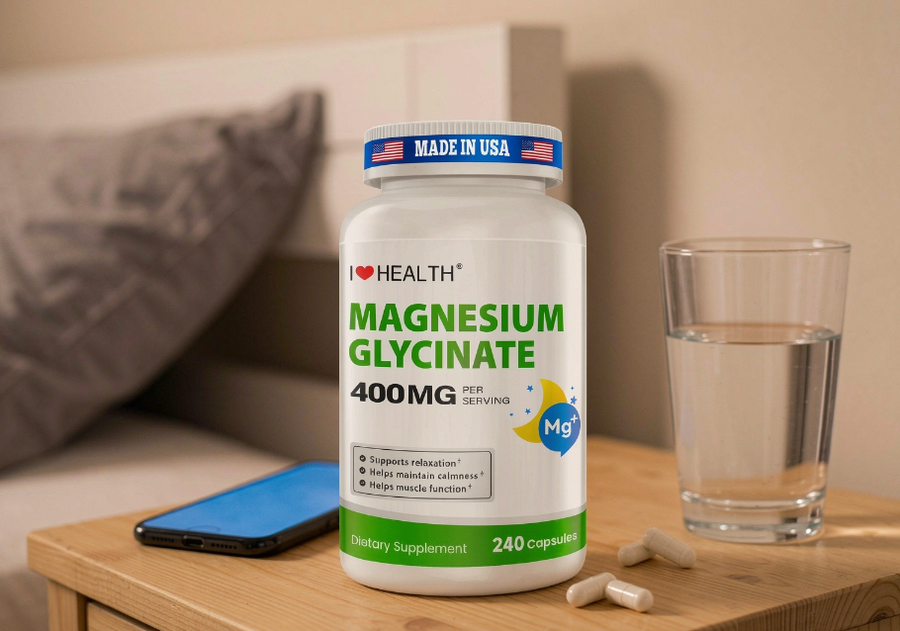

Magnesium glycinate 400 mg can mean two very different things. If 400 mg refers to the complete magnesium glycinate compound, it may provide only about 56 mg of elemental magnesium. If the Supplement Facts panel lists “Magnesium 400 mg,” then the serving provides 400 mg of elemental magnesium, which is above the official adult upper limit for magnesium from supplements.
Before deciding how much to take or when to take it, check three details:
- The elemental magnesium amount
- The number of capsules in one serving
- Whether the formula contains pure glycinate, buffered glycinate, or several magnesium forms
These details matter more than the large number on the front of the bottle.
Is 400 mg Magnesium Glycinate a Lot?
The direct answer is: 400 mg of the glycinate compound is not a large amount, but 400 mg of elemental magnesium is a relatively high supplemental amount.
Pure magnesium glycinate is approximately 14 percent elemental magnesium by weight. Based on that proportion, 400 mg of the compound would provide about 56 mg of elemental magnesium.
The calculation is:
400 mg × 14% = approximately 56 mg of elemental magnesium
However, this calculation is only an estimate. Commercial products may use buffered glycinate, additional magnesium sources, or different ingredient specifications. Always use the elemental magnesium declared in the Supplement Facts panel instead of calculating the amount from the front label alone.
If the Supplement Facts panel lists 400 mg of magnesium per serving, the product provides 400 mg of elemental magnesium. That is 50 mg above the adult supplemental upper limit of 350 mg established by the National Academies and reported by the National Institutes of Health Office of Dietary Supplements.
This does not mean that 400 mg is automatically toxic. It means that 400 mg of supplemental elemental magnesium is above the amount recommended for unsupervised daily use. A healthcare professional may use a different amount for a specific reason, but that decision should consider diet, kidney function, medications, and individual health needs.

What Does the 400 mg Number Usually Refer To?
There is no single answer. The position and wording of the number determine what it means.
When 400 mg appears on the front label
A front label that says magnesium glycinate 400 mg may be describing:
- The total weight of the magnesium glycinate ingredient
- The amount in one capsule
- The amount in a full serving of several capsules
- A blend containing glycinate and other magnesium forms
- The elemental magnesium supplied by the full serving
The front panel alone may not provide enough information to distinguish these possibilities.
When the Supplement Facts panel says “Magnesium 400 mg”
This usually means the serving contains 400 mg of elemental magnesium. The mineral source may appear beside or beneath the amount, such as:
Magnesium 400 mg, as magnesium glycinate
The NIH explains that the Supplement Facts panel declares the amount of elemental magnesium, not the weight of the complete magnesium compound. The FDA dietary supplement labeling guide also explains how dietary ingredients, serving sizes, and amounts per serving should be presented.
When the ingredient list says “Magnesium glycinate 400 mg”
This wording may describe the complete compound rather than elemental magnesium. If the product is pure magnesium glycinate, 400 mg of compound may supply approximately 56 mg of magnesium.
The correct elemental amount should still appear on the Magnesium line in the Supplement Facts panel.

A Simple Label Example
Imagine that a bottle shows the following information:
Front label: Magnesium Glycinate 400 mg
Supplement Facts: Serving size: 1 capsule Magnesium: 56 mg Source: Magnesium glycinate
This product supplies 56 mg of elemental magnesium per capsule. The 400 mg number describes the compound.
Now consider another product:
Front label: Magnesium Glycinate 400 mg
Supplement Facts: Serving size: 4 capsules Magnesium: 400 mg Source: Magnesium bisglycinate chelate
This product supplies 400 mg of elemental magnesium per four capsule serving. One capsule would provide 100 mg.
Although both bottles display 400 mg, their doses are very different. This is why serving size and elemental magnesium must be read together.
The NIH Dietary Supplement Label Database contains real supplement labels, including an example of a magnesium glycinate product listing 400 mg of magnesium per two tablets. The example shows why the full label matters more than the product name alone.
When Should You Take Magnesium Glycinate 400 mg?
For an evening routine, take it with dinner or approximately 30 to 60 minutes before bedtime. If you prefer morning use, take it with breakfast. There is no official requirement to take magnesium glycinate at night.
Your best timing depends on your reason for taking it and how your stomach responds.
Take it in the evening for a bedtime routine
Many people choose magnesium glycinate in the evening because this timing is easy to remember and fits a relaxation routine. Taking it 30 to 60 minutes before bed is a practical starting point.
Magnesium is not a sleeping pill, and the evidence for magnesium glycinate as a direct treatment for insomnia remains limited. Do not expect it to make you fall asleep at an exact time.
Take it with food if your stomach is sensitive
Take the serving with breakfast or dinner if magnesium causes nausea, cramping, or digestive discomfort. Food may make the supplement easier to tolerate.
Magnesium glycinate is generally chosen for its gentle digestive profile, but large supplemental amounts can still cause diarrhea or stomach discomfort.
Split a high elemental amount
If a healthcare professional has recommended 400 mg of elemental magnesium, dividing it into two servings may be easier to tolerate than taking the entire amount at once.
A practical schedule would be:
- 200 mg with breakfast
- 200 mg with dinner or before bed
Do not use this schedule simply because the front label says 400 mg. First confirm that the number represents elemental magnesium, then confirm that the amount is appropriate for you.
Consistency matters more than the clock
Take magnesium at a time you can follow consistently. Changing the time every day makes it harder to understand how your body responds.
If morning use makes you feel unusually relaxed or tired, move it to the evening. If evening use does not suit you, morning use is acceptable.

How Does 400 mg Compare With 100 mg, 200 mg, and 500 mg Labels?
The comparison depends on whether each number describes compound weight or elemental magnesium.
The following estimates assume pure magnesium glycinate containing approximately 14 percent elemental magnesium:
| Label amount for the compound | Approximate elemental magnesium |
| 100 mg | 14 mg |
| 200 mg | 28 mg |
| 400 mg | 56 mg |
| 500 mg | 70 mg |
These estimates do not apply when the label number already represents elemental magnesium.
A Supplement Facts panel listing “Magnesium 200 mg” supplies 200 mg of elemental magnesium, even if the source is magnesium glycinate. A front panel listing “Magnesium glycinate 200 mg” may refer to 200 mg of compound.
When comparing products, use this order:
- Compare elemental magnesium per serving.
- Check how many capsules make one serving.
- Identify the magnesium source.
- Review additional ingredients.
- Calculate the cost per elemental serving.
A 500 mg product is not automatically stronger than a 400 mg product. The 400 mg product could provide more elemental magnesium if its number refers to elemental content while the 500 mg product lists only compound weight.
When comparing different strengths, you can review the I Love Health magnesium glycinate range, which includes 400 mg, 500 mg, and 1000 mg options. Always confirm the elemental magnesium and serving size shown on the specific product label before choosing a strength.
Pure, Buffered, and Blended Magnesium Glycinate
The word “glycinate” does not guarantee that every product has the same composition.
Pure magnesium glycinate
Pure magnesium glycinate binds magnesium to glycine. Because glycine accounts for much of the compound weight, pure glycinate provides a relatively modest proportion of elemental magnesium.
Buffered magnesium glycinate
Buffered glycinate often contains magnesium oxide in addition to the chelated ingredient. Magnesium oxide has a higher percentage of elemental magnesium by weight. Adding it can increase the declared elemental amount while keeping the serving manageable.
A buffered formula is not automatically inferior, but it should be clearly identified. People who choose glycinate specifically for digestive comfort may want to know how much of the magnesium comes from oxide.
Magnesium blends
Some products combine glycinate with citrate, malate, taurate, or oxide. The Supplement Facts panel may list one total magnesium amount, while the ingredient list identifies the different sources.
Do not assume that the entire elemental amount comes from glycinate unless the label clearly says so.
What Safety Limit Should Supplement Users Know?
For adults, the official upper limit is 350 mg of elemental magnesium per day from supplements and magnesium containing medications.
This limit does not include magnesium naturally present in food. Healthy kidneys normally remove excess magnesium obtained from food, so the same upper limit is not applied to dietary sources.
The distinction between total intake and supplemental intake is important:
| Reference value | What it includes |
| Adult RDA of 310 to 420 mg | Food, beverages, supplements, and medications combined |
| Adult upper limit of 350 mg | Supplements and magnesium containing medications only |
Adult men generally need 400 to 420 mg per day in total. Adult women generally need 310 to 320 mg. Pregnancy and other life stages can change these requirements.
A person may therefore need 400 mg per day in total without needing a 400 mg supplement. Food may already supply a significant part of that amount.
Common food sources include pumpkin seeds, chia seeds, almonds, spinach, beans, whole grains, and fortified cereals. One ounce of pumpkin seeds provides 156 mg, while one ounce of almonds provides 80 mg, according to the NIH.
Side Effects and Medication Considerations
The most common signs that a supplemental amount is too high are:
- Diarrhea
- Nausea
- Abdominal cramping
Stop taking the product and seek professional advice if symptoms are persistent or severe.
People with impaired kidney function should not take high magnesium doses without medical supervision. Reduced kidney function can limit the body’s ability to remove excess magnesium and increase the risk of toxicity.
Magnesium may also interact with:
- Tetracycline antibiotics
- Quinolone antibiotics
- Oral bisphosphonates
- Certain diuretics
- Proton pump inhibitors
A pharmacist can advise whether your magnesium and medication doses need to be separated. Do not guess the spacing because the correct interval depends on the specific medicine.
Pregnant or breastfeeding adults and people managing a medical condition should obtain individualized advice before starting a high elemental dose.
Confirm the Elemental Magnesium Amount First
Magnesium glycinate 400 mg is not enough information to determine the real dose.
If 400 mg refers to pure magnesium glycinate compound, it may provide about 56 mg of elemental magnesium. If the Supplement Facts panel lists 400 mg of magnesium, the serving provides 400 mg of elemental magnesium and exceeds the official adult supplemental upper limit of 350 mg.
For timing, take it with dinner or 30 to 60 minutes before bed if you want it in an evening routine. Morning use is also acceptable. If a clinician recommends 400 mg of elemental magnesium, splitting the amount between morning and evening may improve tolerance.
Always check the elemental magnesium, serving size, mineral source, and total magnesium from every supplement or medication you use. Those four details tell you far more than the largest number on the bottle.